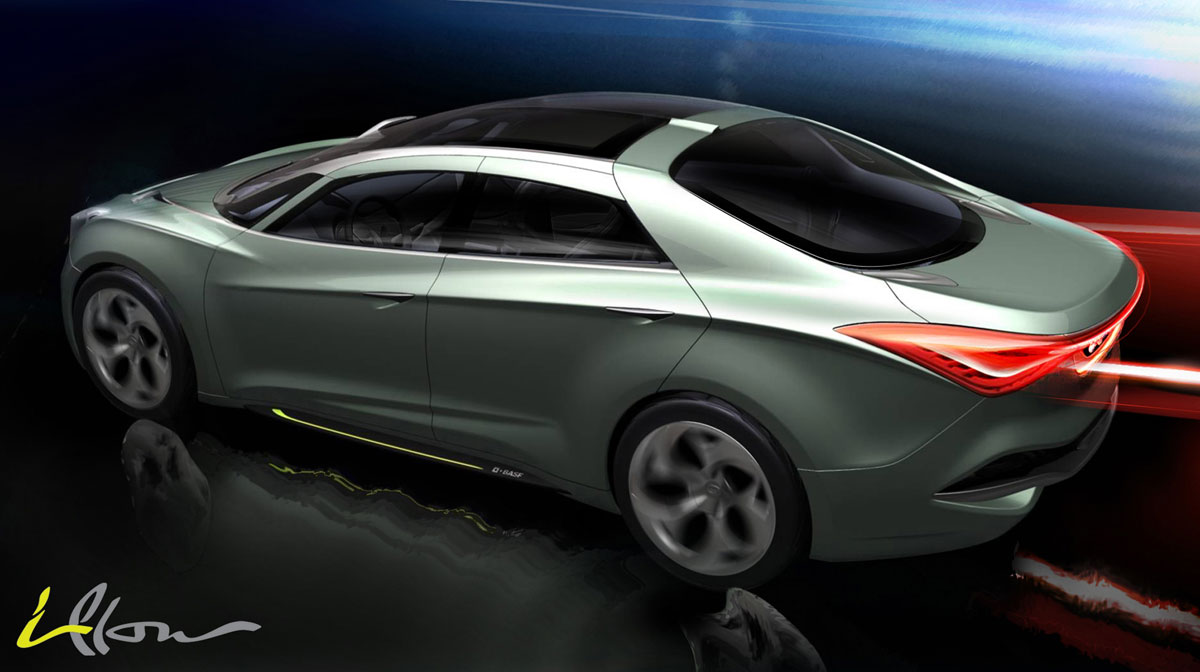
Hyundai HED-5 i-Mode Concept, 2008


The Hyundai introduce a new concept car which hints at a future MPV production model and showcases advanced technologies. The Hyundai HED-5, named "i-Mode" is a six-seater people carrier that incorporates high-tech materials, an advanced seating concept and state of the art communication technology in a completely new vehicle.
By working together with the partners Bayer MaterialScience AG, Keiper and LG Electronics, Hyundai is continuing a cross-industry co-operation to drive new technologies faster to market. The co-operation with Bayer MaterialScience enabled the radical design of the Hyundai HED-5 to be implemented more quickly. The materials used are lighter and more adaptable than the metal and glass they replace.
In combination with a light weight body construction, reduces fuel consumption and CO2 emissions. Self-healing water based bodywork finishes from Bayer add to the environmentally friendly concept of the vehicle and even let minor scratches magically disappear by themselves. The i-Mode is the first vehicle to feature the new "BayVision" glazing system and Collimator headlight lenses made from Makrolon®.
Through the advanced entertainment concept developed by LG electronics, the vehicle becomes an extension of the digital home, allowing passengers to stay connected, communicate and interact in the car. Access to the web, video games, movies or video calling are all possible through the pop-down touch-screen displays and webcams, located within the overhead console. A wireless network enables a selection of cable-free keyboards, game controllers and headphones to further personalise the entertainment experience. The advanced developments seen on the i-Mode give a dynamic indication of real possibilities for the near future.
Hyundai's engineering partner Keiper supported the i-Mode project with the exclusive world premiere of its new and unique Swivel Seat concept. The first row passenger seat rotates to face second and third row occupants. When the seat is turned, the backrest converts into a comfortable seat surface. This is made possible by a fully concealed, power-operated kinematic system. The integrated seatbelt system - another technically advanced debut - and the adjustable headrest maximize passive safety for passengers in either sitting position. The second row bench slides rearwards to increase comfort and create a social area.
The Hyundai HED-5 i-Mode concept demonstrates the increasing awareness Hyundai has towards environmental issues. Cooperation with Bayer Material Science has seen use of the innovative glazing alternative 'Makrolon', enabling the car to have extended transparent areas, reducing weight and increasing fuel economy.
The Hyundai HED-5 "i mode" includes the hexagonal shaped grill, which symbolises the new brand identity for Europe. This feature, previously showcased on earlier Hyundai concept cars, demonstrates the consistency in developing a coherent design language. It is through such characteristics that Hyundai aim to enhance the perceived quality and recognition of their products.
Through the door opening mechanism, the interior is in the form of a lounge compartment. The interior represents the concept of social space, an environment where all occupants can enjoy safe travel in comfort, surrounded by sophisticated technology and luxurious materials.
The seats, which offer first class comfort for all occupants, combining a modern look with innovative functionality. The Cognac leather cushions and the burgundy lacquered seat structure give the occupants a lounge atmosphere without the limitations of a conventional automotive interior layout.
The light beige headliner, which continues through into the pillars, provides the interior with a floodlit, almost roofless panoramic appearance. The horizontal trim colour division, between dark and light tones further emphasises this.
All-new R Diesel with Two-Stage Turbocharging
i-Mode is powered by an all-new 2.2-litre R diesel engine which first passes the intake air through a low-pressure turbocharger from where it is forced into a high-pressure turbocharger for maximum boost: 158kw (215ps) and 47kg.m of peak torque (461 Nm). The R Engine has a power density in excess of 70kw per litre putting Hyundai diesel technology in the same class as any leading German automaker. When its low-end torque of 30kg.m is compared with the 19kg.m of low-end torque delivered by the standard R Engine, one quickly appreciates the value of dual-stage turbo charging.
The R Engine is a smooth-shifting 6-speed automatic gearbox. Even at maximum loads, the engine does not incur fuel consumption penalties thanks to its high capacity for exhaust gas recirculation that also benefits efforts to reduce NOx emissions. The R Engine is assured of meeting future, more stringent EU exhaust emission standards.
By working together with the partners Bayer MaterialScience AG, Keiper and LG Electronics, Hyundai is continuing a cross-industry co-operation to drive new technologies faster to market. The co-operation with Bayer MaterialScience enabled the radical design of the Hyundai HED-5 to be implemented more quickly. The materials used are lighter and more adaptable than the metal and glass they replace.
In combination with a light weight body construction, reduces fuel consumption and CO2 emissions. Self-healing water based bodywork finishes from Bayer add to the environmentally friendly concept of the vehicle and even let minor scratches magically disappear by themselves. The i-Mode is the first vehicle to feature the new "BayVision" glazing system and Collimator headlight lenses made from Makrolon®.
Through the advanced entertainment concept developed by LG electronics, the vehicle becomes an extension of the digital home, allowing passengers to stay connected, communicate and interact in the car. Access to the web, video games, movies or video calling are all possible through the pop-down touch-screen displays and webcams, located within the overhead console. A wireless network enables a selection of cable-free keyboards, game controllers and headphones to further personalise the entertainment experience. The advanced developments seen on the i-Mode give a dynamic indication of real possibilities for the near future.
Hyundai's engineering partner Keiper supported the i-Mode project with the exclusive world premiere of its new and unique Swivel Seat concept. The first row passenger seat rotates to face second and third row occupants. When the seat is turned, the backrest converts into a comfortable seat surface. This is made possible by a fully concealed, power-operated kinematic system. The integrated seatbelt system - another technically advanced debut - and the adjustable headrest maximize passive safety for passengers in either sitting position. The second row bench slides rearwards to increase comfort and create a social area.
The Hyundai HED-5 i-Mode concept demonstrates the increasing awareness Hyundai has towards environmental issues. Cooperation with Bayer Material Science has seen use of the innovative glazing alternative 'Makrolon', enabling the car to have extended transparent areas, reducing weight and increasing fuel economy.
The Hyundai HED-5 "i mode" includes the hexagonal shaped grill, which symbolises the new brand identity for Europe. This feature, previously showcased on earlier Hyundai concept cars, demonstrates the consistency in developing a coherent design language. It is through such characteristics that Hyundai aim to enhance the perceived quality and recognition of their products.
Through the door opening mechanism, the interior is in the form of a lounge compartment. The interior represents the concept of social space, an environment where all occupants can enjoy safe travel in comfort, surrounded by sophisticated technology and luxurious materials.
The seats, which offer first class comfort for all occupants, combining a modern look with innovative functionality. The Cognac leather cushions and the burgundy lacquered seat structure give the occupants a lounge atmosphere without the limitations of a conventional automotive interior layout.
The light beige headliner, which continues through into the pillars, provides the interior with a floodlit, almost roofless panoramic appearance. The horizontal trim colour division, between dark and light tones further emphasises this.
All-new R Diesel with Two-Stage Turbocharging
i-Mode is powered by an all-new 2.2-litre R diesel engine which first passes the intake air through a low-pressure turbocharger from where it is forced into a high-pressure turbocharger for maximum boost: 158kw (215ps) and 47kg.m of peak torque (461 Nm). The R Engine has a power density in excess of 70kw per litre putting Hyundai diesel technology in the same class as any leading German automaker. When its low-end torque of 30kg.m is compared with the 19kg.m of low-end torque delivered by the standard R Engine, one quickly appreciates the value of dual-stage turbo charging.
The R Engine is a smooth-shifting 6-speed automatic gearbox. Even at maximum loads, the engine does not incur fuel consumption penalties thanks to its high capacity for exhaust gas recirculation that also benefits efforts to reduce NOx emissions. The R Engine is assured of meeting future, more stringent EU exhaust emission standards.


 The i-Blue features a futuristic H2O flow-form on the inside, which results in a relaxing, stretched-out seating position for the driver and passengers. Drivers of the i-Blue will be excited about the innovative, aircraft-like steering wheel that integrates touch-scroll control pads, enabling the driver to keep his hands on the wheel while operating the vehicles audio-visual systems. The 3D vision head-up display (HUD) also adds safety